
Choose a place small enough to understand
A photo essay does not need to explain an entire neighbourhood. One shared courtyard, repair table or community noticeboard can provide a manageable subject. Begin with a question about how the place is used. A narrow question makes it easier to notice details and easier to recognize what your photographs cannot establish.
For this exercise, imagine a courtyard used for several activities during a weekend. You have permission to work there, and you will explain the project to identifiable participants. The example is fictional. Its purpose is to give the editing decisions a concrete setting without assigning a story or a social problem to real people you have not met.
Observe before deciding on the sequence
Make an initial visit without treating every moment as a required photograph. Notice entrances, routes, places to sit and objects that seem to change hands. Ask participants what the space is used for. Their accounts may reveal a function that would not be obvious from its appearance.
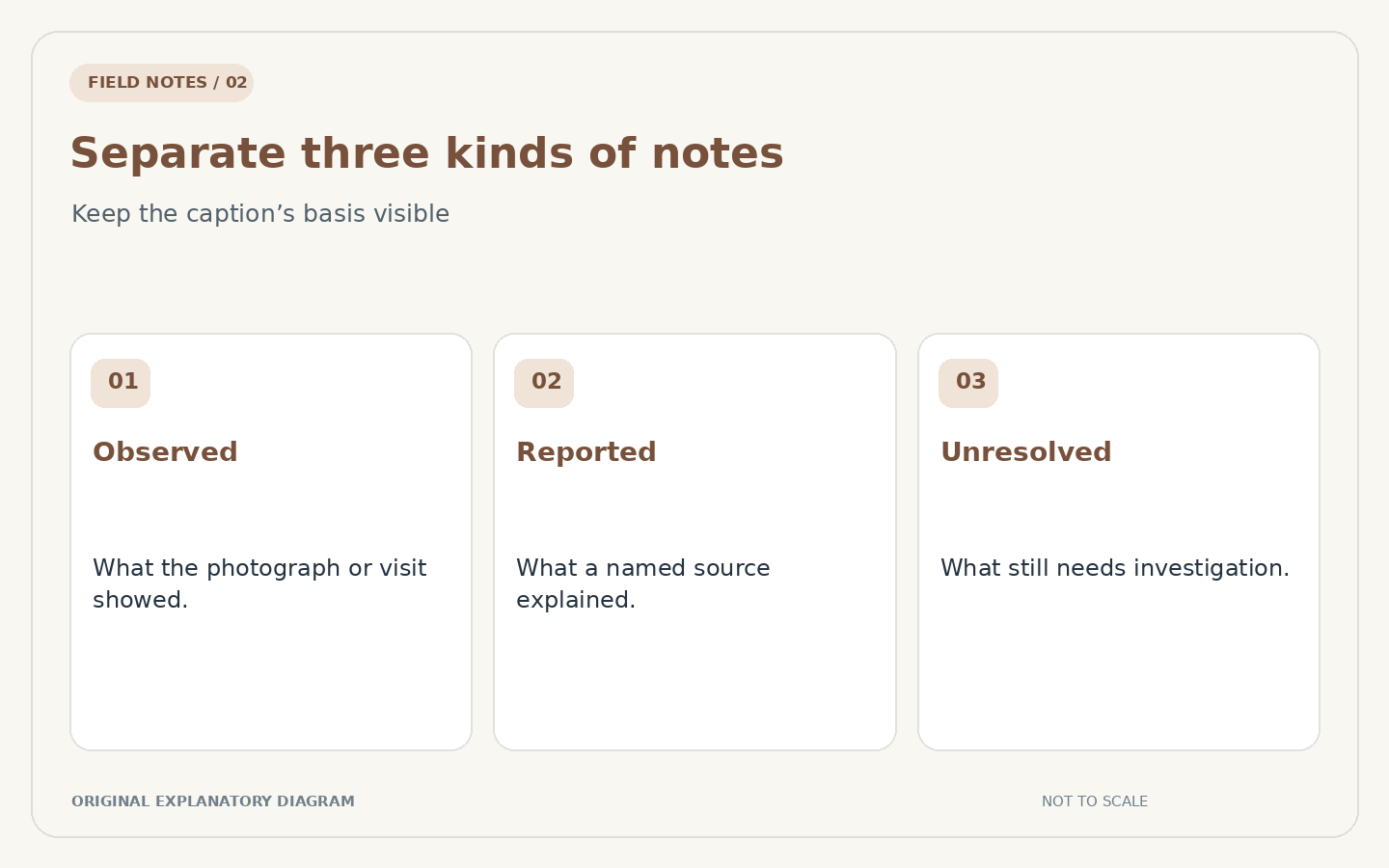
The Library of Congress’s photograph-analysis guide separates observation, interpretation and questions for further investigation. That distinction is useful while making an essay as well as while studying an existing image. A visible arrangement can suggest a question without answering it. [1] Keep a note of what you saw beside what someone explained, so the later caption can distinguish those sources of information.
Find an opening that gives the reader a foothold
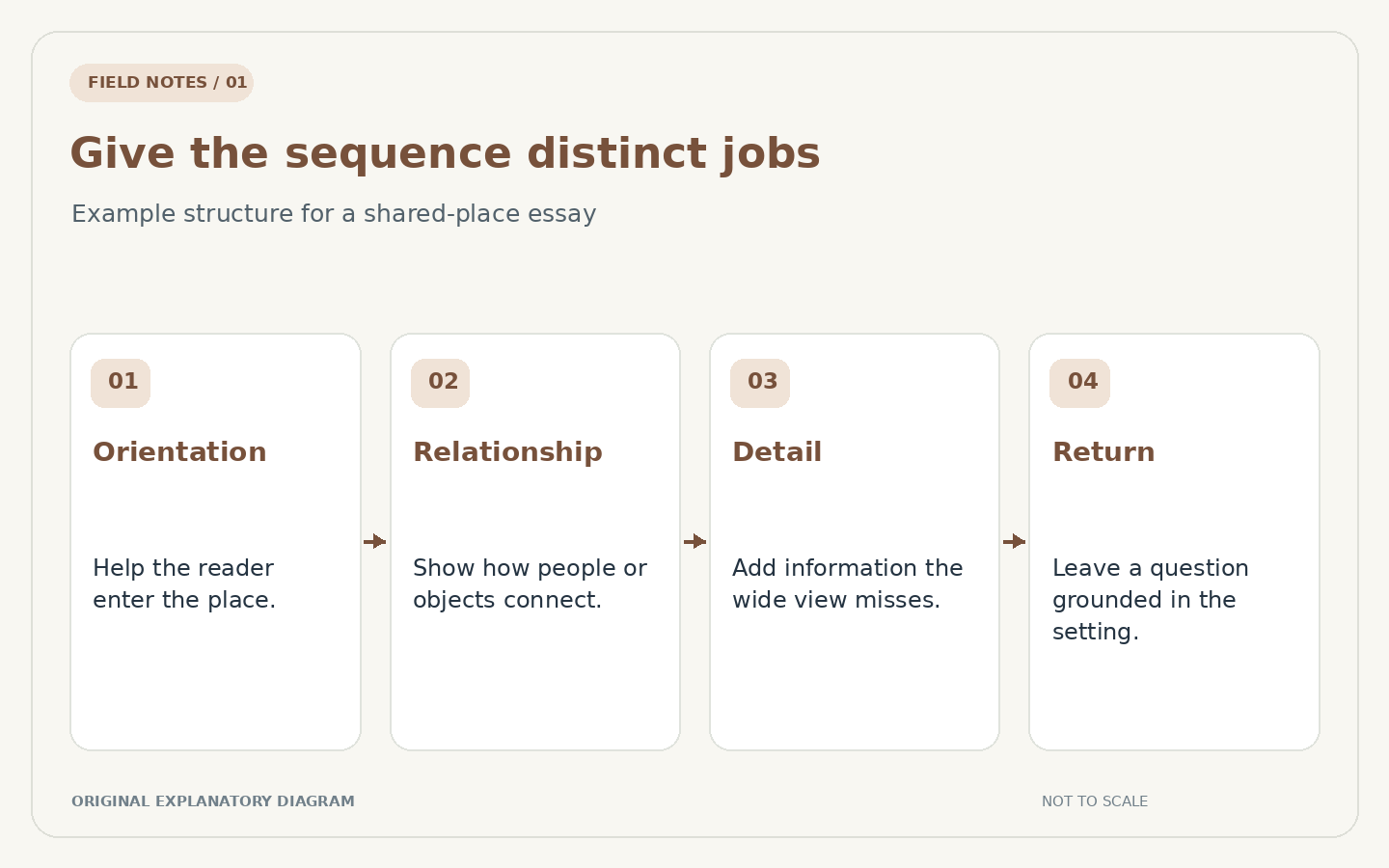
An opening image should help the reader enter the subject. It might establish the courtyard’s layout or show a small action that raises a clear question. Do not assume the most dramatic photograph is automatically the best first image. A strong opening depends on what the sequence will ask the reader to understand next.
Lay two possible openings beside the same second image. Describe the expectation each creates. A wide view may orient the reader before a detail; a close detail may create curiosity that the wide view later resolves. Both can work. Choose the relationship that fits the actual material rather than copying an impressive arrangement from an unrelated essay.
Give each image a distinct job
After the opening, look for photographs that add different information. One might show how people share a work surface; another might show the tools needed for an activity. A quieter image can explain the setting in a way that another expressive portrait cannot. Variety is useful when it advances understanding, not simply when it changes the visual style.
Write a short sentence under each candidate image: this photograph adds something about access, cooperation, maintenance or another specific aspect of the place. If two sentences are identical, examine whether both photographs are needed. You may keep them for a meaningful comparison, but make that reason explicit. A shorter sequence with clear relationships can be stronger than a longer collection of individually attractive frames.
Keep context attached to people
The National Press Photographers Association’s ethics guidance emphasizes accurate representation, context, respect for subjects and editing that preserves the integrity of what was photographed. These principles are especially relevant when a sequence invites readers to draw conclusions about a community. [2]
A person standing alone in one frame may have arrived before everyone else. A crowded table may reflect a short activity rather than constant conditions. Ask what a reader could reasonably infer and whether the captions provide the necessary context. The goal is not to remove all ambiguity from photographs. It is to avoid building a confident social claim from a moment that cannot support it.
Use transitions to connect, not invent
Two neighbouring images can create an implied relationship even when they show different events. If a picture of a broken chair follows a portrait, viewers may connect the person with the damage. Consider whether the sequence encourages an inference you have no basis to make.
Try inserting a contextual image or changing the order. You can also explain that the photographs come from different visits. The transition should help the reader understand the material rather than manufacture a cause-and-effect story. During editing, ask someone unfamiliar with the project to describe what they think happened. Their account can reveal an unintended connection that was invisible to you because you already knew the circumstances.
Allow ordinary activity to carry the story
A shared place can be interesting through repeated use: a table being prepared, a tool returned, a notice updated. These actions may reveal care and organization without supplying a dramatic confrontation or a sentimental ending. Notice them because they contribute to the question, not because they make a community look uniformly harmonious.
If the material includes disagreement or an unresolved problem, describe it accurately and with context. Do not force every photograph into a predetermined theme of either resilience or decline. A thoughtful essay can hold several realities together. Its coherence comes from the question and the sequence, while its credibility comes from remaining responsive to what was actually encountered.
Review the sequence at its intended size
A photograph that is easy to read on a large monitor may become confusing in a small online layout. View the essay in the form readers will use. Check whether captions remain attached, whether the order is clear and whether meaningful details survive the display size.
Invite feedback from someone who knows the place and someone who does not. They can reveal different problems: a missing piece of context, an unclear transition or a caption that assumes local knowledge. Listening does not require surrendering every editorial decision. It gives you better information with which to make those decisions and a chance to correct factual mistakes before the essay circulates.
Keep a contact sheet of the shortlisted images beside the final sequence. It can help you see which aspects of the place received repeated attention and which appeared only once. This is an editing aid rather than a requirement to include every category. If the sequence feels narrow, return to the project’s question before deciding whether another visit or a smaller claim would be more useful.
End with an opening for further attention
The final image does not have to solve the place. It might return to an earlier view with a new detail or leave the reader considering how the space will be used next. Choose an ending that fits the scope of the work. A small essay should not claim to have settled the future of an entire community.
Keep a record of the images, captions and dates used in the final sequence. If the story is revisited later, that record will help distinguish what changed from what was merely photographed differently. The completed essay becomes a precise invitation to look: a sequence about a shared place, shaped by editorial choices and grounded in information that can be explained.
Sources
- Teacher’s Guide: Analyzing Photographs and Prints — Library of Congress
- Visual Integrity and the NPPA Code of Ethics — National Press Photographers Association